Introduction
March 20, 2026, marked a turning point in Indian healthcare. On that date, the patent on semaglutide — the active molecule behind blockbuster weight-loss and diabetes drugs Ozempic and Wegovy — expired in India. Within 24 hours, more than 40 Indian pharmaceutical companies began launching their own versions at prices slashed by up to 90%. What was once a treatment reserved for the affluent is rapidly becoming accessible to millions of Indians living with obesity and Type 2 diabetes.
This is not a minor market event. Semaglutide is one of the best-selling prescription drugs on the planet, with global revenues crossing $26 billion in 2024. India, home to nearly 90 million people with diabetes and over 250 million adults with obesity, represents one of the largest untapped markets for this class of drug. With generic competition now unleashed, the country is set to become a global test case for how affordable GLP-1 therapy reshapes public health in a middle-income nation.
The Patent Expiry: What It Means and Why India is First
A pharmaceutical patent grants its holder exclusive rights to manufacture and sell a drug for a fixed period, typically 20 years from the date of filing. Once a patent expires, other manufacturers can legally produce the same molecule without a license from the originator company. These copies are called generic drugs.
Semaglutide’s patent expired in India on March 20, 2026. This makes India one of the first major pharmaceutical markets in the world where generics can compete freely. In the United States and Europe, patent protection on semaglutide is expected to remain in place until the 2031–2032 timeframe, giving India nearly a decade’s head start on affordable access.
The reason India sees this expiry earlier relates to the specific patent claims filed in each country and the structure of patent law across jurisdictions. India’s Patents Act, and its historically stricter criteria for what qualifies as a patentable innovation under Section 3(d), means certain extensions available in other markets did not apply here.
For generic manufacturers, this is not a moment to be missed. The total market opportunity for Indian generic drugmakers from semaglutide is estimated to exceed ₹50,000 crore across India, select regulated markets, and other emerging economies. By year-end 2026, core patents on semaglutide will have expired in 10 countries representing 48% of the global obesity burden, including Brazil, China, South Africa, Turkey, and Canada. Indian companies are already positioning themselves to serve those markets too.
Which Indian Companies Have Launched Generic Semaglutide?
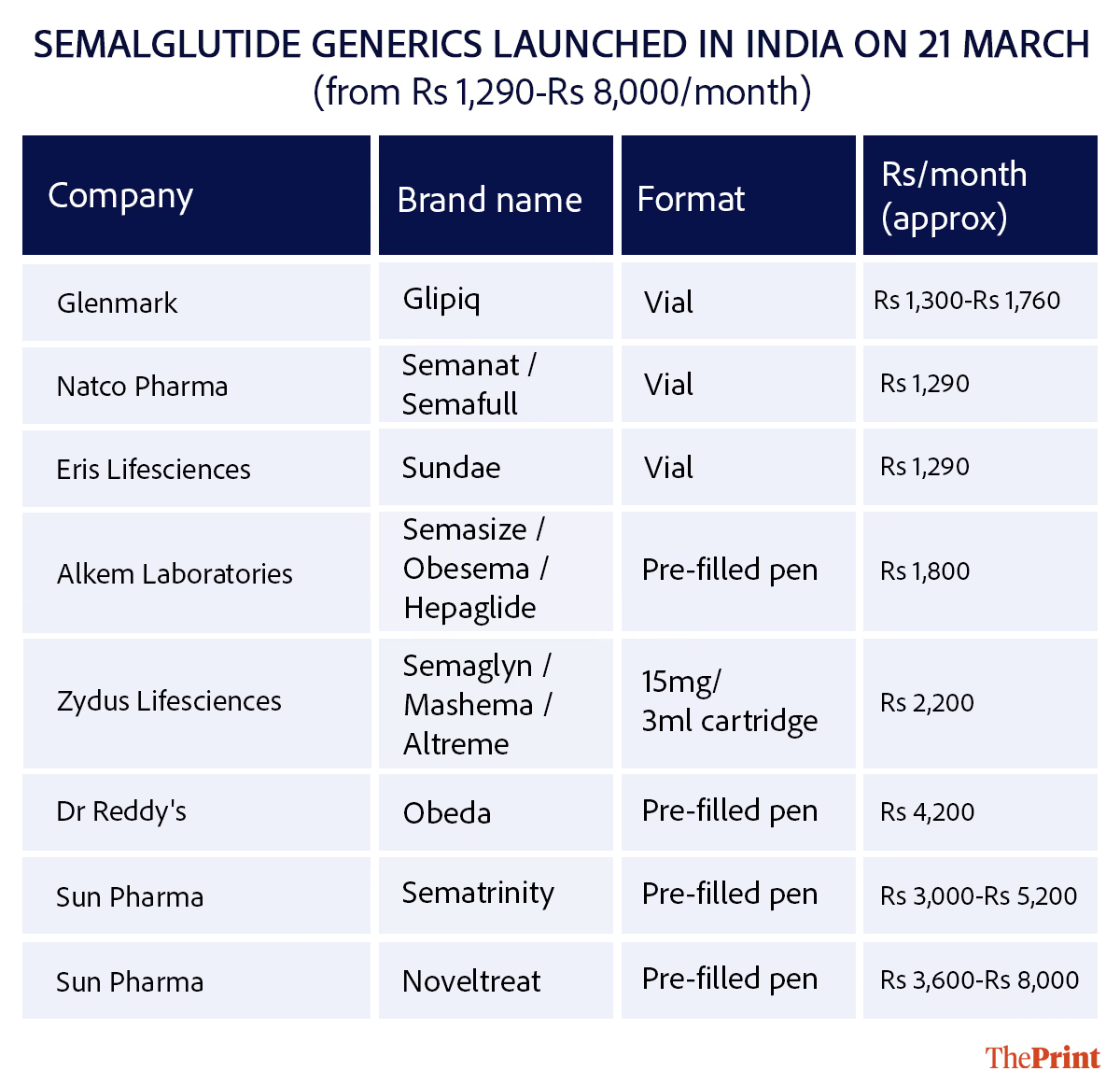
More than 50 brand names are expected across the Indian market through 2026, from over 40 manufacturers. Here is a breakdown of the major players:
Natco Pharma
Natco Pharma was among the earliest movers, receiving CDSCO approval in February 2026. It launched under two brand names: SEMANAT(multi-dose vial) and SEMAFULL (pen device).
On March 21, the day after patent expiry. Natco is particularly notable for being the first company to offer semaglutide in a vial format in India, enabling customised dosing and more flexible cost management for patients.
Pricing starts at ₹1,290 per month for the lowest dose in the vial format, rising to ₹4,500 per month for the pen device at higher doses.
Eris Lifesciences
Eris Lifesciences launched its version under the brand name Sundae, with pricing similar to Natco.
The company had entered into a strategic partnership with Natco the previous month to co-commercialise semaglutide.
With the lowest entry point in the market set at ₹220 per shot in a multi-dose vial, Eris is among the most aggressively priced entrants.
Dr. Reddy’s Laboratories
Dr. Reddy’s Laboratories received approval for a generic version for Type 2 diabetes and has announced plans to launch 12 million pens in its first year. Dr. Reddy’s launched OBEDA generic semaglutide for type 2 diabetes and weight management in India.
The company has also unveiled the Semakare patient assistance app and announced plans to open 65 obesity clinics in the coming months, differentiating itself through patient support infrastructure rather than price alone.
Notably, Dr. Reddy’s has declared its intention to target 87 countries as semaglutide patents fall globally.
Dr. Reddy’s Rebrands Semaglutide Drug ‘Olymra’ After Court Ruling
Dr. Reddy’s Laboratories will rename its semaglutide drug from “Olymviq” to “Olymra” after a ruling by the Delhi High Court. The court found the earlier name too similar to Ozempic by Novo Nordisk, citing potential patient safety risks.
Sun Pharma
Sun Pharma India’s largest pharmaceutical company, received CDSCO approval in December 2025 and is launching under the brand name Noveltreat. The product comes in five dose strengths via a prefilled pen and is positioned as a cardiometabolic therapy.
Zydus Lifesciences
Zydus Lifesciences is entering with a reusable pen format under brand names Semaglyn, Mashema, and Altreme. The company is emphasising sustainability and cost efficiency through the reusable delivery format.
Glenmark Pharmaceuticals
Glenmark Pharmaceuticals has entered with its GLIPIQ brand, priced at ₹325 per week in vial format, targeting affordability for patients initiating advanced diabetes therapy.
Mankind Pharma
Mankind Pharma is launching under the brand name Samakind, targeting a broad therapeutic scope including diabetes, obesity, cardiology, orthopaedics, and gynaecology. It plans to leverage its distribution reach in smaller cities and towns, a key differentiator as urban pharmacy networks are already served by innovator brands.
Alkem Laboratories
Alkem Laboratories launched on March 21, 2026, under three brand names — Semasize, Obesema, and Hepaglide — at a price point of ₹450 per week (approximately ₹1,800 per month).
Beyond these, companies including Lupin, Cipla, Torrent, and Ajanta Pharma are preparing launch
How Much Does Generic Semaglutide Price in India in 2026?
The pricing collapse is dramatic. Prior to the patent expiry, branded semaglutide in India was priced as follows:
- Novo Nordisk’s branded Ozempic cost between ₹8,800 and ₹11,175 per month, and
- Wegovy cost up to ₹16,400 per month
Novo Nordisk Lowers Ozempic and Wegovy Prices Again as Generic Rivals Gain Ground in India
On March 31, 2026, Novo Nordisk has reduced the prices of its popular medications Ozempic and Wegovy in India for the second time, aiming to stay competitive against lower-cost generic alternatives from local manufacturers.
Generic competition has shattered these price points. As of March 2026
The lowest-priced entry is Eris’s multi-dose vial at ₹220 per shot. Glenmark’s GLIPIQ starts at ₹325 per week. Natco’s vial-based Semanat starts at ₹1,290 per month. Alkem’s pre-filled pen version is priced at ₹1,800 per month (₹450 per week). Pen device formats from Natco and other companies range from ₹4,000 to ₹4,500 per month.
Prices have fallen by as much as 90% from the branded version, with device formats ranging from reusable pens to affordable vials.
The Real Problem Generics Solve: Adherence, Not Just Access
One of the most under-discussed aspects of expensive chronic medication is the high rate of mid-treatment dropout. Semaglutide is not a short-course antibiotic. It is a lifestyle drug. One that must be continued indefinitely for sustained benefit. When patients stop taking it, weight typically returns, and metabolic complications including diabetes risk can re-emerge.
When treatment costs ₹15,000–₹22,000 per month, abandonment is the norm rather than the exception. Patients who see initial results but cannot afford to continue simply stop.
With generics pushing monthly costs toward ₹1,500–₹5,000, the calculus changes. Patients can realistically sustain treatment across the seven to eight months required to see meaningful, stable outcomes and beyond.
This is the real promise of affordable semaglutide: not just more people starting treatment, but more people finishing it and maintaining the metabolic benefits long-term.
Why Americans and Europeans Wait Longer for Semaglutide Generics
People in the United States and Europe are waiting longer for generic versions of semaglutide mainly because of stronger patent protections.
Although drug patents usually last 20 years, companies like Novo Nordisk often spend many years on research and approvals. To make up for this lost time, the US and Europe allow “patent term extensions,” which give companies extra years of exclusive rights to sell the drug.
These rules were introduced after pharmaceutical companies argued that longer protection encourages innovation and investment in new medicines.
In contrast, countries like India do not offer such extensions, which allows generics to become available sooner.
Hetero and Dr. Reddy’s rolls out generic semaglutide exports to over 75 countries
Hetero announced that it has started exporting its generic semaglutide injection range to over 75 countries.
At the same time, Dr. Reddy’s Laboratories is also aims to offer significantly lower-priced alternatives and expand globally, intensifying competition in this fast-growing segment.
Risks and Responsible Use: What Patients Must Know
Wider access comes with serious responsibilities. Semaglutide is a powerful prescription-only drug a Schedule G medication in India and is not suitable for everyone. Common side effects include nausea, vomiting, diarrhoea, and abdominal discomfort, particularly during the dose escalation period.
Doctors and endocrinologists are raising specific concerns as the Indian market opens up:
Quality consistency
Semaglutide is a biologic peptide produced using recombinant DNA technology a far more complex manufacturing process than producing a standard chemical compound. With over 40 companies racing to market, questions about whether all generics will meet the same efficacy and safety standards as the original are legitimate.
Cold chain management
Unlike tablets, injectable semaglutide must be maintained within a specific temperature range throughout transportation and storage. Failure to maintain the cold chain can compromise drug efficacy and patient safety.
Frequently Asked Questions
Is generic semaglutide as effective as branded Ozempic or Wegovy?
Yes, when manufactured properly and stored correctly, generic semaglutide contains the identical active molecule at the same dosage strengths. Indian regulatory authorities require bioequivalence studies demonstrating that one unit of the generic molecule delivers the equivalent therapeutic effect to one unit of the originator molecule before granting approval. Patients should ensure their prescribed generic comes from a reputable manufacturer with CDSCO approval.
Can I buy semaglutide over the counter in India without a prescription?
No. Semaglutide is a Schedule G prescription drug in India. It must be dispensed only with a valid prescription from a qualified physician. Using it without medical supervision exposes patients to serious risks.
Does health insurance cover generic semaglutide in India?
Currently, semaglutide is not on India’s National List of Essential Medicines and is not covered under any government health scheme including Ayushman Bharat. Patients pay entirely out of pocket.
What happens if I stop taking semaglutide?
Weight tends to return after semaglutide is discontinued, often relatively rapidly. This is because the drug is managing appetite and metabolic regulation rather than permanently altering them. Patients should discuss any planned discontinuation with their physician to manage this transition properly.
Disclaimer:
This content is provided for informational and educational purposes only and does not constitute medical advice, diagnosis, or treatment. Semaglutide is a prescription medication and should only be used under the guidance and supervision of a qualified healthcare professional. Always consult your doctor or a licensed medical provider before starting any medication or treatment.
All brand names, product image, trademarks, and registered trademarks mentioned are the property of their respective owners.